
This ClickUp review 2026 covers everything you need to know before committing to one of the most feature-rich project management tools on the market. But does it live up to the hype? This review covers everything you need to know before you commit.
What is ClickUp?
ClickUp is a cloud-based productivity platform founded in 2017. It brings together task management, documents, team chat, time tracking, goal setting, whiteboards, and automation under one roof. It currently serves teams ranging from solo freelancers to Fortune 500 companies, and positions itself as a direct alternative to juggling multiple tools like Asana, Notion, Trello, and Monday.com.
Key Features
ClickUp offers over 11 different ways to view your work, including List, Board, Gantt, Calendar, and Mind Map views. This level of flexibility is genuinely rare at this price point.
Task management is the core strength. You can create custom fields, custom statuses, and subtasks, and assign tasks to multiple team members. Automations allow you to eliminate repetitive admin work with 100-plus automation triggers across all paid plans.
Documents and whiteboards are built directly into the platform. You can create collaborative docs linked to tasks, run real-time brainstorming sessions on a whiteboard, and convert ideas into trackable action items without leaving the app.
Time tracking is available on all plans including the free tier, which is rare among competitors. You can log hours manually or use the built-in timer, and mark time as billable for client invoicing.
ClickUp integrates with over 1,000 applications including Slack, Google Workspace, Zapier, GitHub, and Trello.
Pricing
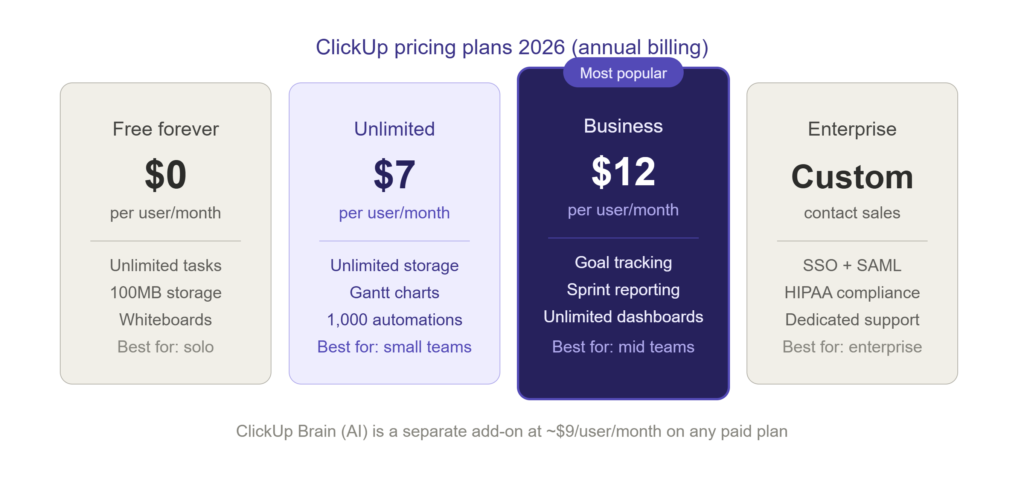
ClickUp uses per-member, per-month pricing across four tiers (all prices reflect annual billing). ClickUp Brain, the AI assistant, is a separate add-on at approximately $9 per user per month on top of any paid plan.
Pros & Cons
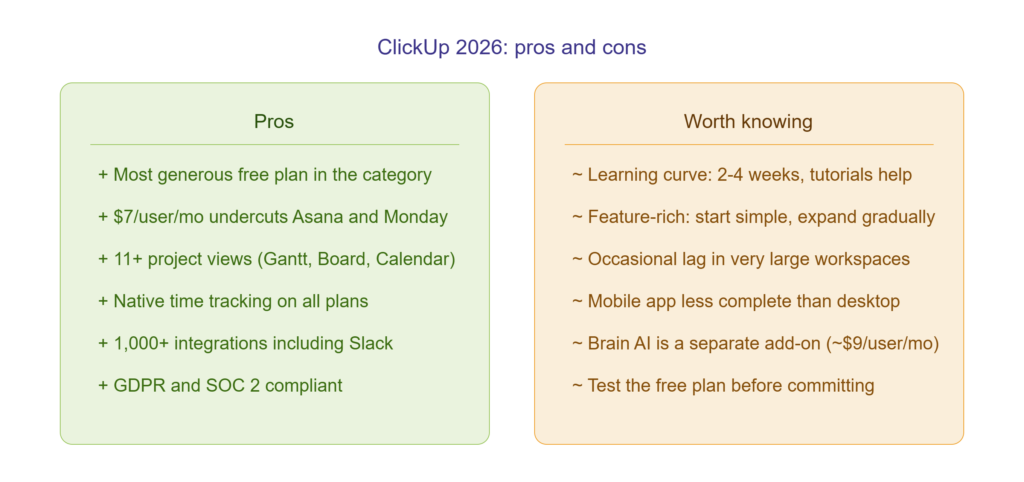
Here is a balanced overview of what to expect before you commit.
Who is ClickUp best for?
ClickUp works best for the following types of users:
Project managers who need Gantt charts, task dependencies, and time tracking in one place. ClickUp maps directly to the planning and monitoring frameworks covered in PMP and PRINCE2 certifications.
Small to medium teams who want to consolidate multiple tools. If your team currently uses separate apps for tasks, documents, and communication, ClickUp can replace all of them.
Freelancers and consultants managing multiple client projects simultaneously. The free plan alone is sufficient for solo professionals getting started.
Remote and hybrid teams who need a shared workspace with clear task ownership, deadlines, and progress visibility.
Students and early-career project managers who want to build practical PM tool experience before entering the job market.
APM qualification candidates and UK-based project professionals preparing for the APM PMQ or ChPP. ClickUp’s structured workspace approach aligns well with the APM Body of Knowledge framework, particularly around planning, risk, and stakeholder management.
ClickUp Alternatives: Who Should Look Elsewhere?
ClickUp is not the right fit for everyone.
Teams who need a simple, plug-and-play solution with minimal setup should consider Trello instead. Trello has a much shallower learning curve and works well for straightforward task tracking.
Organisations that rely heavily on mobile working may find the ClickUp mobile app limiting compared to the desktop version.
Solo users who only need a basic to-do list will find ClickUp’s feature depth unnecessary. A simpler tool will serve them better.
ClickUp Review 2026: Our Verdict
ClickUp is one of the strongest value propositions in project management software in 2026. The free plan alone is worth exploring before you commit to any paid subscription. For teams willing to invest time in setup and configuration, the Unlimited plan at $7 per user per month delivers outstanding capability at a price point most competitors cannot match.
Try ClickUp for free and see if it fits your workflow before committing to a paid plan.
To understand how modern project management frameworks are evolving, read our companion guide: The Death of the Iron Triangle: Inside the July 2026 PMP Exam Overhaul.